sandwich panel line
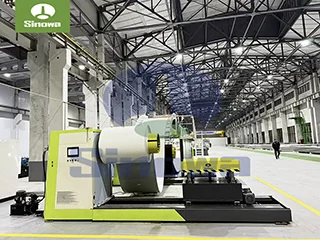
The overall operational framework of the continuous PU sandwich panel production system follows a scientific linear production rhythm, with every functional module maintaining precise synchronous coordination to support continuous and stable mass production. The entire production flow starts from the automatic unwinding and feeding of surface base materials, which supports continuous release of various coil materials to ensure uninterrupted material supply for subsequent processing. After unwinding, the surface materials enter the leveling and pretreatment unit, where multi-group roller sets eliminate surface wrinkles and uneven deformation, while professional preheating devices adjust the material surface temperature to an optimal range. This pretreatment process effectively avoids internal bubble generation and interface delamination caused by temperature mismatches during subsequent foaming and composite reactions. Every parameter in the pretreatment stage is intelligently adjustable, adapting to different material characteristics and production requirements. The standardized pretreatment lays a solid foundation for uniform foaming and firm composite bonding, ensuring the basic surface flatness and structural stability of finished panels while reducing product defect rates in the follow-up process.
Raw material precision metering and high-pressure mixing is the core functional link that determines the core performance of PU sandwich panels, serving as the key to stable product quality of the entire production system. This specialized module is equipped with integrated storage, conveying, metering and mixing devices for liquid polyurethane raw materials, realizing accurate proportional distribution of different PU components. The system adopts high-precision metering units to control the feeding volume of each raw material in real time, avoiding performance fluctuations caused by uneven material ratios. After precise proportioning, raw materials are sent to the high-pressure mixing chamber for rapid and uniform blending, forming a homogeneous liquid mixture with stable chemical activity. The whole mixing process is carried out in a closed environment to prevent external impurity pollution and raw material volatilization. The uniformly mixed PU liquid is evenly injected between the upper and lower surface materials through an optimized spraying structure, ensuring the raw material can fully fill the composite gap and lay the groundwork for forming a dense, uniform foam core layer with excellent thermal insulation and mechanical properties.
Foaming reaction and composite lamination molding constitutes the key forming stage of PU sandwich panels, directly defining the structural form and comprehensive performance of finished products. With the continuous operation of the conveyor system, the injected liquid PU mixture undergoes gradual physical foaming and chemical cross-linking reactions inside the closed composite cavity. The foaming material expands steadily and fills the entire space between the upper and lower base materials uniformly, forming an integrated sandwich structure. The molding section is equipped with multiple groups of precision pressure roller sets, which apply constant and uniform pressure to the composite board structure. This stable pressure control ensures tight fitting between the PU foam core and surface materials, effectively avoiding hollow layers, gaps and uneven thickness. Meanwhile, the synchronous operating speed of the roller system matches the foaming expansion rate of PU materials perfectly, balancing the foaming density and structural compactness of the core layer. The closed molding environment maintains stable reaction conditions, enabling the formation of a fine closed-cell foam structure that endows the panel with outstanding thermal insulation, sound insulation and pressure resistance.
Constant-temperature thermal curing and synchronous traction conveying are essential processes to stabilize the structural performance of composite panels and ensure continuous production progress. After composite molding, the initially formed sandwich panels enter the constant-temperature curing channel, where a stable thermal environment promotes complete chemical cross-linking and solidification of the PU foam core. The intelligent temperature control system adjusts the internal temperature of the curing channel in real time according to panel thickness and production speed, ensuring thorough curing of the foam core without overheating deformation of surface materials. Sufficient curing treatment eliminates residual reaction stress inside the panel, significantly improving the structural stability and service durability of finished products. Equipped with a high-stability synchronous traction system, the production line delivers uniform and stable traction force to drive continuous forward movement of panels. The traction speed maintains precise linkage with foaming, lamination and curing parameters, ensuring consistent production rhythm and avoiding panel stretching, deformation or incomplete curing caused by mismatched operating speeds of different units.
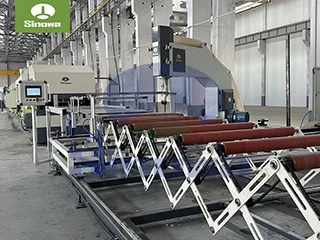
Fixed-length cutting and edge finishing processes complete the final standardized shaping of continuous long-strip sandwich panels. After full curing and preliminary shaping, the continuous panel materials are sent to the intelligent cutting unit, which supports real-time length measurement and automatic positioning according to preset product specifications. The cutting system adopts high-hardness wear-resistant cutting tools and optimized cutting structures, which can complete high-efficiency cutting operations with smooth and burr-free sections without squeezing or damaging the panel structure. The intelligent tracking function can automatically correct positioning deviations caused by continuous production errors, ensuring consistent dimensional accuracy of each finished panel. In addition to fixed-length cutting, the edge finishing unit trims irregular edges of panels to unify the overall specification and appearance quality. This refined processing link effectively solves the problems of uneven edges and dimensional errors in continuous molding, making the finished panels meet uniform installation and assembly requirements and improving the overall aesthetic and installation adaptability of products.
Finished product conveying, automatic stacking and post-processing sorting form the final terminal link of the complete production system, realizing automated collection and standardized output of finished panels. After cutting and finishing, qualified panels are stably transported to the stacking area through the low-noise conveying system, which is designed with anti-scratch structures to protect the panel surface from damage during conveying. The automatic stacking device accurately stacks finished panels according to preset stacking specifications, realizing orderly arrangement of products and replacing traditional manual stacking operations. This automated mode greatly improves stacking efficiency and ensures consistent stacking regularity, avoiding panel tilting, collision and surface abrasion caused by manual operation. The system is also equipped with an intelligent sorting function, which can preliminarily screen products with minor appearance defects through real-time monitoring, realizing separation of qualified products and defective products. The integrated terminal processing process simplifies post-production procedures, reduces manual intervention, and improves the overall automation level and operational efficiency of the entire production line.
The integrated design and intelligent control system endows the continuous PU sandwich panel production system with outstanding operational advantages and wide application flexibility. All functional units of the production line adopt centralized synchronous control, realizing one-key start-stop and parameter unified adjustment, which simplifies operation procedures and reduces the requirement for manual operation skills. The system supports flexible switching of production parameters, enabling rapid adjustment of panel thickness, foaming density and production speed to meet diversified production demands. The fully closed and continuous production structure effectively reduces raw material waste and energy consumption, realizing energy-saving and efficient production. In addition, the modular design of the production line facilitates daily maintenance and later functional upgrading, ensuring long-term stable operation of the equipment. With its advantages of high automation, stable product quality and strong production capacity, this complete production system has become a core equipment solution for modern efficient manufacturing of PU sandwich composite panels.
https://www.cnsinowa.com/sandwich-panel-machines/continuous-pu-sandwich-panel-line-complete-production-system.html