sandwich panel line
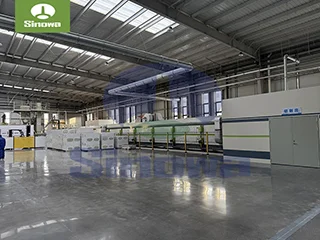
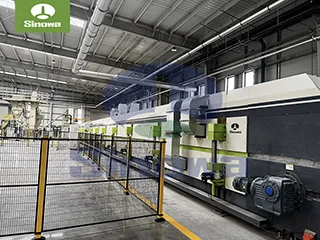
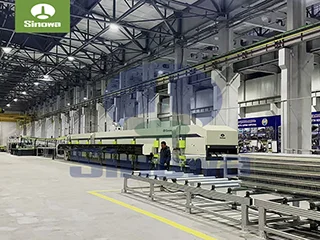
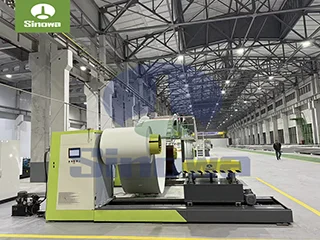
The overall structural design of the continuous PU sandwich panel line with automatic stacker focuses on integration, stability, and operational continuity, covering every essential procedure from raw material input to finished product storage without redundant manual links. The front-end part of the line adopts an automatic unwinding and leveling system, which steadily releases and flattens metal or non-metal surface materials to ensure consistent flatness and tension of base materials throughout the production process, laying a solid foundation for subsequent composite processing. Following the feeding unit is the precision PU foaming and spraying system, which achieves uniform mixing and quantitative spraying of polyurethane raw materials through dynamic proportional control. The oscillating coating gantry ensures that the foaming material is evenly distributed on the surface of the base plate, avoiding local hollowing, uneven thickness, or insufficient bonding that often occur in manual or semi-automatic foaming processes. The middle lamination and curing unit adopts a constant-temperature closed environment, enabling sufficient foaming, solidification, and bonding of PU materials, which enhances the overall structural tightness and mechanical stability of the sandwich panels. Every functional unit is precisely matched in operating rhythm to realize non-stop continuous production, fundamentally improving production continuity compared with segmented traditional equipment.
The automatic stacker, as the core upgraded module of the entire production line, is the key component that distinguishes high-end fully automatic PU sandwich panel production equipment from ordinary semi-automatic lines and undertakes all terminal finished product processing work. Different from simple mechanical handling devices, this stacker is equipped with high-precision vacuum suction grabbing components and multi-axis servo driving systems, which can stably and accurately grab finished panels without causing surface scratches, deformation, or damage. After the panels are cut to fixed lengths and conveyed to the stacking station by the conveyor platform, the stacker’s intelligent sensing system automatically identifies panel specifications, positions the grabbing points accurately, and completes orderly stacking according to preset program parameters. The servo-driven crosshead structure supports flexible adjustment of stacking height, spacing, and arrangement mode, adapting to different panel thicknesses, lengths, and usage requirements. This automated stacking mode completely replaces manual carrying and stacking, effectively reducing labor intensity and eliminating human errors in manual sorting and placement.
One of the most prominent advantages of the continuous PU sandwich panel line with automatic stacker is its remarkable improvement in production efficiency and output stability. Traditional intermittent panel production lines require frequent startup and shutdown, manual material transfer, and artificial sorting of finished products, resulting in discontinuous production rhythms and low effective output. In contrast, this continuous production line realizes uninterrupted cyclic operation of feeding, foaming, lamination, curing, cutting, and stacking, with no idle time between production links. The coordinated operation of all mechanical units maintains a stable production speed, ensuring consistent unit-time output throughout long-term continuous operation. The matched automatic stacker can synchronously complete stacking work in line with the production speed of the front-end processing units, avoiding product accumulation and production stagnation caused by delayed manual stacking. This synchronous matching of front-end processing and terminal stacking greatly improves the overall operational efficiency of the production line, enabling large-scale batch production while maintaining stable output capacity without quality fluctuations caused by speed adjustment.
This automated production line delivers outstanding product quality consistency, solving the common quality defects of traditional sandwich panel production. In the PU foaming stage, the precision proportional mixing and uniform spraying system ensures that the polyurethane foam layer has consistent density, thickness, and pore structure across all panels, providing stable thermal insulation and shock absorption performance for finished products. The constant-temperature lamination and curing system standardizes the foaming and bonding reaction environment, enabling tight integration between the surface base material and the PU core layer, effectively avoiding delamination, cracking, and poor bonding strength. The fixed-length cutting unit adopts high-precision numerical control cutting technology to ensure uniform panel size and neat cutting edges without burrs or irregular shapes. Furthermore, the automatic stacker’s standardized grabbing and stacking process avoids extrusion, collision, and uneven placement of finished panels during manual handling, protecting the finished product appearance and structural integrity to the greatest extent. All production links are precisely controlled by intelligent programs, realizing unified product specifications and stable performance indicators for each batch of products.
In terms of operational cost and labor optimization, the continuous PU sandwich panel line with automatic stacker brings significant economic advantages for production enterprises. Traditional PU sandwich panel production requires multiple workers to be stationed at feeding, material transfer, finished product sorting, and stacking posts, resulting in high long-term labor costs and unstable staffing. The fully integrated automated design of this line realizes unmanned operation in core production and terminal stacking links, only requiring a small number of operators to conduct real-time monitoring, parameter adjustment, and routine equipment inspection. The automatic stacking system replaces repetitive and high-intensity manual handling work, reducing labor input while lowering the risk of operational accidents caused by manual work. In addition, the precise material control system of the production line effectively reduces the waste of PU raw materials and base materials, improving raw material utilization efficiency. The stable and continuous operation of the equipment also reduces defective product rates and rework costs, further optimizing the overall production cost structure and improving the economic benefits of panel manufacturing.
The intelligent control system equipped on the production line greatly simplifies operation management and daily maintenance, improving the overall intelligence level of panel manufacturing. The intuitive human-computer interaction interface allows operators to complete parameter setting, production speed adjustment, and product specification switching in a simple and convenient manner, with real-time display of the operating status of each functional unit of the equipment. The system has built-in intelligent fault diagnosis and early warning functions, which can automatically monitor the operating state of mechanical transmission, foaming control, and stacking modules, and timely prompt abnormal conditions such as parameter deviation and equipment operation failure. This function helps maintenance personnel quickly locate faults and complete troubleshooting, reducing equipment downtime and improving production continuity. Meanwhile, the modular structural design of the production line facilitates daily cleaning, component inspection, and parts replacement, lowering the difficulty and cost of routine maintenance. Some advanced control configurations also support real-time production data statistics, providing accurate data support for production scheduling and output management.
With the continuous upgrading of composite panel manufacturing requirements, the continuous PU sandwich panel line with automatic stacker has become a mainstream development trend in the panel manufacturing industry due to its high efficiency, intelligence, and high stability. Its continuous integrated production mode adapts to the large-scale and standardized production needs of modern building materials and industrial composite panels, while the automatic stacking function realizes standardized and orderly storage of finished products, facilitating subsequent packaging, transportation, and warehouse management. Compared with traditional production equipment, this line not only improves production efficiency and product quality but also promotes the standardized and intelligent upgrading of the entire panel production process. It can flexibly adapt to the production of PU sandwich panels with different specifications and application scenarios, with strong production flexibility and equipment compatibility. As market demands for high-quality insulation composite panels continue to rise, this automated continuous production line will maintain strong application value and market competitiveness in the field of sandwich panel manufacturing.
https://www.cnsinowa.com/sandwich-panel-machines/continuous-pu-sandwich-panel-line-with-automatic-stacker.html