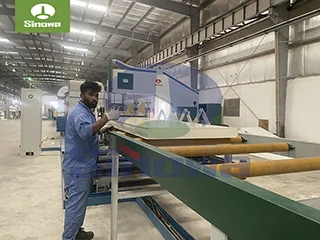
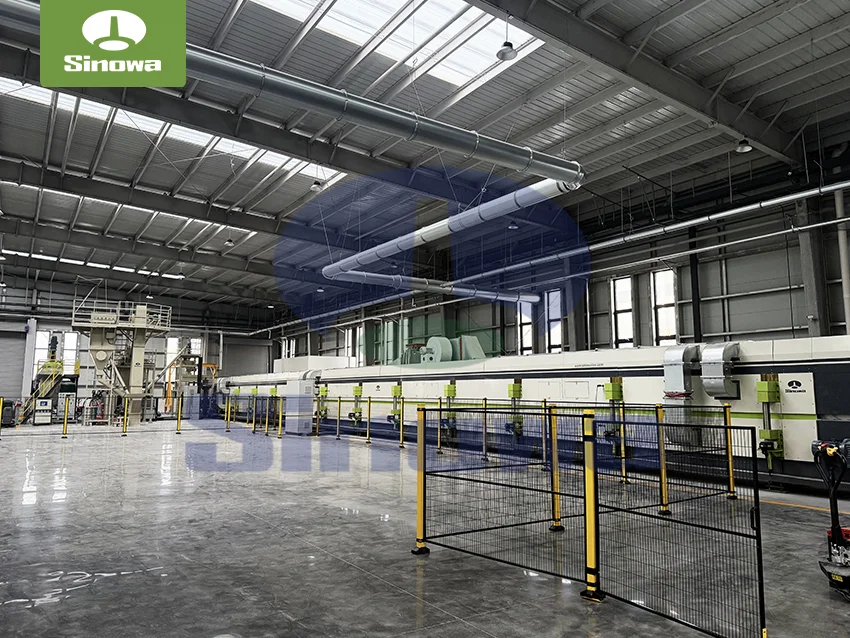
 sandwich panel line
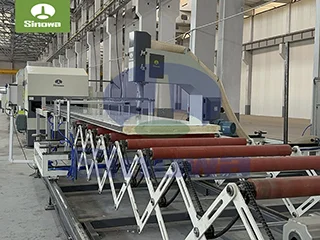
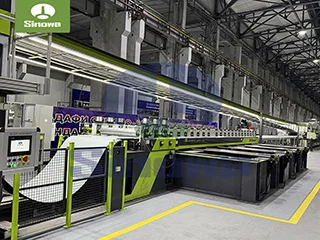
The operational framework of the continuous PU sandwich panel production line is built on the precise synchronous coordination of multiple independent functional modules, each undertaking exclusive production tasks while maintaining seamless linkage with adjacent processes. The whole production process starts from the automatic unwinding and splicing of surface base materials, where metal coils are steadily released and jointed smoothly to ensure continuous material supply without frequent shutdowns. Subsequent surface pretreatment and roll forming processes flatten and shape the base materials into standardized profiles, eliminating surface wrinkles and deformation that may affect the final panel quality. Before PU material injection, the preheating module conducts uniform temperature treatment on the formed surface materials, which enhances the adhesion activity between metal surfaces and polyurethane foam and avoids delamination caused by temperature difference during foaming. All these front-end processes are regulated by a unified intelligent control system, which dynamically adjusts transmission speed and processing parameters according to real-time production conditions, laying a stable foundation for the subsequent foaming and composite molding procedures and ensuring the overall continuity and stability of the production chain.
The polyurethane raw material mixing and injection system serves as the core functional unit that determines the internal performance of sandwich panels, adopting high-precision proportional mixing and low-loss injection technology. The system accurately controls the feeding ratio and flow rate of different PU raw materials through pneumatic and hydraulic linkage devices, realizing uniform mixing of reactive components in the closed mixing chamber. This precise mixing mode avoids uneven foaming, local hollowing and inconsistent density caused by manual proportioning or crude mixing equipment. Equipped with optimized pressure-resistant injection nozzles, the system delivers mixed raw materials evenly onto the middle layer of the upper and lower surface materials, forming a uniform liquid material layer ready for foaming and curing. During the injection process, real-time temperature and pressure monitoring modules track the operating state of the mixing system, automatically fine-tuning working parameters to adapt to changes in production speed and material characteristics. This advanced material processing technology ensures that the PU foam core forms a complete closed-cell structure after reaction, endowing the finished panel with excellent thermal insulation and structural stability.
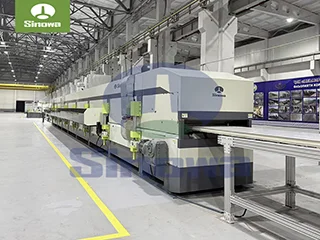
Continuous lamination and pressure forming is a key process that shapes the overall structure of PU sandwich panels, relying on a dual-crawler synchronous pressing mechanism to achieve integrated composite molding. The upper and lower crawler devices clamp the surface materials and injected PU raw materials stably, providing constant and uniform pressing force to offset the expansion pressure generated during polyurethane foaming reaction. This stable pressing environment prevents panel warping, thickness deviation and core layer dislocation, ensuring consistent overall dimensions and flatness of each finished panel. The crawler operation speed is precisely synchronized with the front-end material feeding and injection speed, realizing zero-gap continuous molding without pause or speed fluctuation. In addition, the flexible pressure adjustment function adapts to the production of panels with different thickness specifications, realizing flexible switching of production modes without equipment replacement or major parameter resetting. This integrated lamination and forming process greatly improves the structural integration of sandwich panels, making the combination of surface layer and core layer more compact and durable.
Constant temperature curing and cooling shaping processes are essential links to stabilize the physical performance of PU sandwich panels after composite molding. After lamination and pressing, the preliminary formed panels enter the constant temperature curing channel, where the internal temperature and air circulation state are precisely controlled to promote complete chemical reaction and solidification of the PU foam core. The graded temperature control mode in the curing channel ensures that the foaming reaction proceeds fully and uniformly from the inside to the outside of the core layer, effectively improving the cell uniformity and structural compactness of the foam layer. After sufficient curing, the panels enter the natural cooling and shaping area to release internal stress generated during high-temperature molding and pressure forming, avoiding subsequent deformation and cracking of finished products. The whole curing and cooling process follows the physical and chemical reaction rules of polyurethane materials, with automatic temperature adjustment according to production speed and panel thickness. This standardized curing treatment significantly enhances the structural stability, compression resistance and bonding strength of finished sandwich panels, ensuring long-term stable service performance.
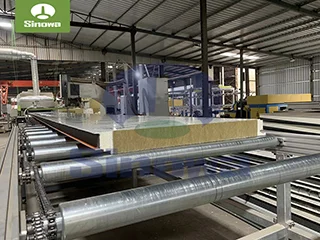
Fixed-length cutting and automatic finishing systems realize the standardized sizing and neat processing of finished PU sandwich panels, completing the final forming of products. The high-precision tracking cutting device follows the continuous conveying speed of panels in real time, achieving dynamic fixed-length cutting without shutdown, which effectively avoids length errors and section burrs caused by static cutting. The cutting system supports flexible setting of different panel lengths, adapting to diversified product specification requirements in different application scenarios. After cutting, the automatic edge trimming and surface finishing modules process the panel edges and surfaces to remove residual foam and burrs, ensuring neat and smooth product appearance. Meanwhile, the intelligent counting and sorting system automatically classifies and arranges qualified products, realizing orderly output of finished panels. Compared with traditional manual cutting and finishing methods, the automated finishing process greatly improves product dimensional accuracy and surface quality, reduces product damage rate, and further enhances the overall yield of the production line.
The intelligent control and linkage operation system is the central brain supporting the efficient and stable operation of the entire continuous PU sandwich panel production line. The system integrates electrical control, pneumatic regulation, hydraulic drive and temperature monitoring modules, realizing centralized management and automatic scheduling of all production links from material feeding to finished product output. Operators can set production parameters, adjust operating modes and monitor real-time production data through a human-machine interaction interface, with the system automatically optimizing the coordination rhythm of each functional module. The built-in fault self-detection function can timely identify abnormal states such as material blockage, parameter deviation and equipment operation failure, and trigger early warning and automatic protection mechanisms to avoid equipment downtime and defective product generation. The highly intelligent control mode minimizes manual operation participation, reduces human error interference, and maintains consistent production rhythm and stable product quality in long-term continuous operation, greatly improving the overall operational efficiency of the production line.
The continuous PU sandwich panel production line delivers prominent comprehensive production advantages and economic benefits compared with traditional intermittent production equipment. In terms of production efficiency, the uninterrupted streamlined operation eliminates frequent startup, shutdown and parameter resetting processes, greatly improving unit-time output and realizing large-scale batch production. In terms of product quality, the full-process automated parameter control and synchronous cooperative processing avoid quality fluctuations caused by manual operation, ensuring consistent thermal insulation performance, structural strength and dimensional accuracy of each batch of panels. In terms of production cost, the precise raw material proportioning system reduces material waste, while high automation lowers labor input and reduces subsequent product rework costs. Moreover, the integrated equipment structure occupies a reasonable space and features stable long-term operation, low failure rate and convenient maintenance. These comprehensive advantages make the production line an ideal choice for modern large-scale manufacturing of PU sandwich panels, effectively meeting the growing market demand for high-performance composite insulation building materials.
https://www.cnsinowa.com/sandwich-panel-machines/industrial-continuous-pu-sandwich-panel-production-line.html