 sandwich panel machine
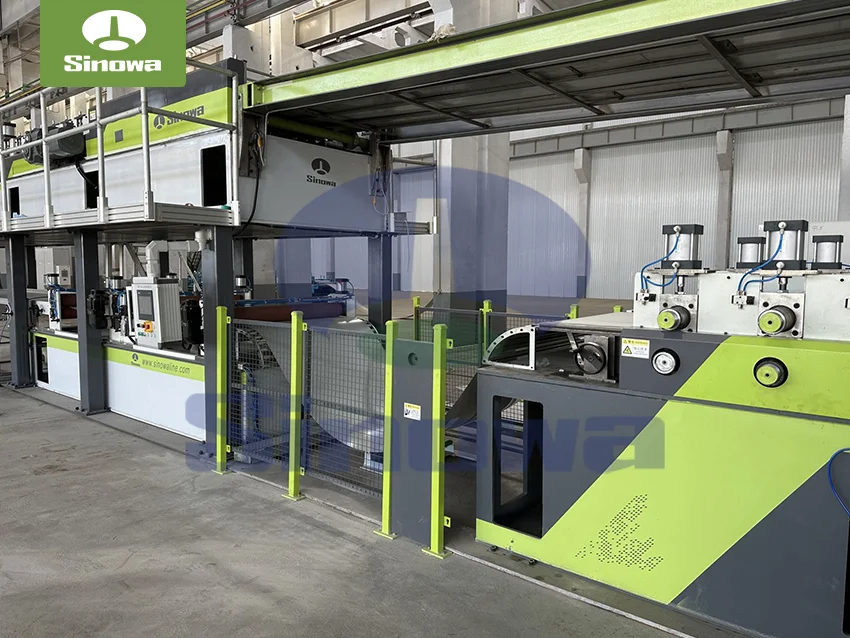
The overall structure of polyurethane sandwich panel manufacturing line presents a highly integrated modular layout, and the entire production line can be functionally divided into multiple interconnected subsystems without independent operation barriers. Each functional module is designed to undertake specific production tasks, and the precise coordination between modules ensures the continuous and stable progress of panel production. The basic equipment combination includes surface material unwinding and pretreatment subsystem, polyurethane raw material metering and mixing subsystem, continuous foaming and composite molding subsystem, constant-temperature curing subsystem, trimming and sizing subsystem, cooling and shaping subsystem, as well as finished product conveying and stacking subsystem. Every subsystem is equipped with independent transmission structures and auxiliary control components, and the whole production line adopts a linear horizontal layout to reduce material transfer resistance and optimize production space utilization. The structural design of the equipment fully considers the characteristics of polyurethane chemical reactions and the physical composite requirements of surface materials, realizing the organic combination of chemical foaming and physical pressing molding.
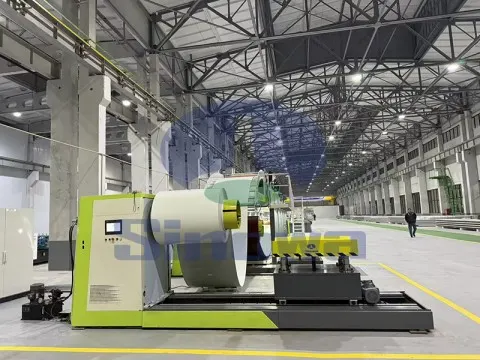
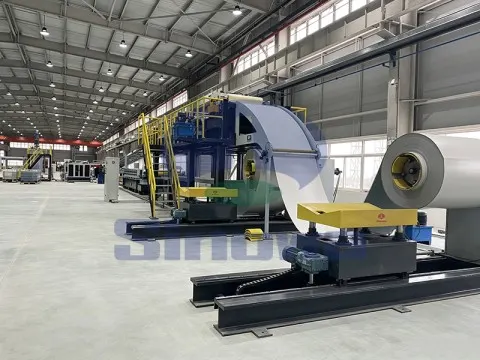
The surface material unwinding and pretreatment subsystem serves as the starting unit of the entire production line, which is responsible for providing continuous and flat base materials for subsequent composite processing. Common surface materials for polyurethane sandwich panels include metal sheets, inorganic fiber plates, and polymer composite films, and different types of surface materials correspond to adjusted unwinding structures. This subsystem is mainly composed of unwinding rollers, tension control assemblies, surface cleaning devices, and preheating components. The unwinding rollers adopt a rotatable cylindrical structure with adjustable clamping tightness, which can fix raw material coils of different specifications to avoid material deviation during high-speed conveying. The tension control assembly adopts mechanical buffer structures to maintain constant material tension in the conveying process, preventing surface material from wrinkling, stretching or warping due to uneven stress. Before composite molding, the surface cleaning device removes dust, oil stains and particulate impurities on the surface of base materials through air blowing and friction cleaning methods; this cleaning process is essential to enhance the bonding tightness between surface materials and polyurethane foam cores. The preheating component heats the surface materials to a stable temperature within a fixed range, eliminating the internal stress generated during the raw material coiling process and improving the compatibility between the surface materials and polyurethane foams in the subsequent bonding reaction. The running speed of this subsystem is synchronized with the overall operating rhythm of the production line to ensure uninterrupted material supply for the follow-up processing units.
The polyurethane raw material metering and mixing subsystem is the core functional unit that determines the foaming quality of the sandwich panel core layer. Polyurethane foam is formed by the chemical reaction between polyether polyol, isocyanate, foaming agent, and auxiliary additives, and the precise proportion of each raw material directly affects the foam density, pore uniformity, and thermal insulation performance. This subsystem consists of raw material storage tanks, filter assemblies, quantitative metering pumps, circulation pipelines, and high-speed mixing heads. The storage tanks adopt sealed thermal insulation structures to isolate external temperature interference and maintain the activity of chemical raw materials; internal filter screens with dense meshes are installed at the discharge ports of the tanks to filter out impurity particles in raw materials and avoid blocking precision metering components. The metering pumps are designed with high-precision transmission structures, which can stably control the output flow of each raw material within a tiny error range. Different from single pump conveying structures, the multi-group parallel metering pump configuration realizes synchronous conveying of multiple raw materials, laying a foundation for uniform mixing. All raw materials are transported to the closed mixing head through pressure-resistant pipelines, and the high-speed rotating stirring blades inside the mixing head drive the raw materials to conduct intense turbulent mixing. The mixing speed is adjustable according to production demands, and the fully mixed liquid polyurethane raw materials are evenly coated on the surface of the lower base material through reciprocating moving distributing components. The whole mixing process is carried out in a closed space to prevent the volatile substances in chemical raw materials from diffusing into the external environment and ensure the safety of the production operation.
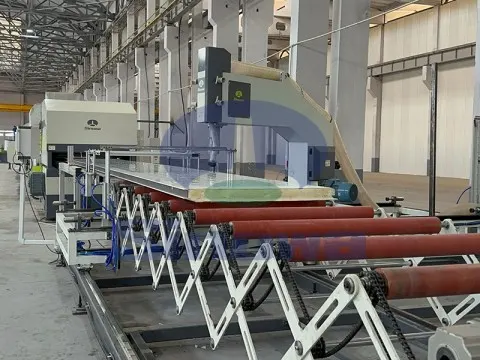
The continuous foaming and composite molding subsystem undertakes the key task of forming the integrated structure of surface materials and polyurethane foam cores, and it is also the most critical pressure-bearing and molding unit in the entire production line. This subsystem is dominated by a double-belt molding machine, supplemented by guiding pressing rollers and deviation correction assemblies. The double-belt molding machine is equipped with upper and lower parallel circulating steel belts, which form a closed molding cavity with a fixed thickness in the middle. After the mixed polyurethane liquid is coated on the lower surface material, the material moves forward with the transmission steel belt, and the upper surface material is gradually covered on the surface of the unconsolidated polyurethane foam through the guiding rollers. With the continuous advancement of materials, the polyurethane liquid undergoes chain expansion reaction in the closed cavity, and the foam gradually fills the space between the upper and lower surface materials. The internal pressure of the molding cavity is kept within a stable range through the mechanical limiting structure of the steel belts, which avoids excessive foam expansion causing uneven panel thickness or surface bulging. The deviation correction assemblies installed on both sides of the double-belt machine can monitor the material transmission track in real time and fine-tune the operating position of the steel belts to ensure that the upper and lower surface materials remain completely aligned during the composite process. The structural rigidity of the double-belt molding machine is extremely high, and it can withstand the expansion pressure generated by polyurethane foaming, maintaining the flatness and dimensional stability of the composite panels in the molding stage. The running speed of the steel belts matches the foaming reaction rate of polyurethane, ensuring that the foam completes preliminary molding before leaving the closed cavity.
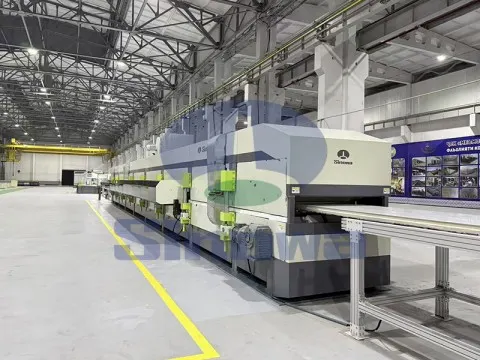
The constant-temperature curing subsystem provides a stable thermal environment for the complete chemical reaction and structural hardening of polyurethane foam. After preliminary composite molding, the internal molecular reaction of polyurethane has not been completed, and the foam structure is soft with low bonding strength. The curing subsystem is composed of an insulated curing oven, circulating heating components, and temperature sensing feedback devices. The interior of the curing oven is divided into multiple independent temperature control sections, and each section can adjust the heating temperature independently to form a gradient temperature field suitable for foam curing. The conventional curing temperature range is maintained between 80 degrees Celsius and 100 degrees Celsius, and the internal hot air circulates continuously through axial flow fans to realize uniform heat distribution without local overheating. The temperature sensing devices distributed inside the oven collect real-time temperature data and feed it back to the central control system; the system automatically adjusts the heating power to offset the temperature fluctuation caused by material entry and exit. The curing time is adjusted according to the production speed and panel thickness, generally controlled between 30 minutes and 60 minutes, so that the polyurethane foam completes molecular cross-linking reaction inside the oven. During the curing process, the bonding interface between the foam core and the surface materials undergoes physical infiltration and chemical adhesion, forming an integrated composite structure with high bonding strength. The insulated shell of the curing oven reduces internal heat loss, improving energy utilization efficiency while maintaining a constant curing temperature.
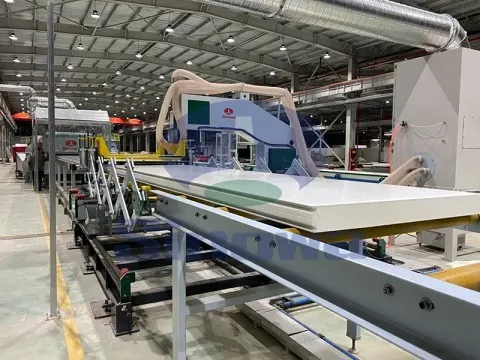
The trimming and sizing subsystem is responsible for removing redundant edge materials and cutting continuous long plates into finished panels with specified dimensions. After curing, the width of the composite panel is slightly larger than the designed size due to material extrusion and foaming expansion, and the edge parts have irregular structures and uneven density, which need to be trimmed to ensure the neat appearance and uniform stress of the finished product. This subsystem includes edge trimming machines, fixed-length cutting devices, and scrap collecting structures. The edge trimming machines are installed symmetrically on both sides of the transmission track, equipped with high-speed rotating alloy cutting blades; the distance between the blades can be adjusted horizontally to adapt to panels of different width specifications. The trimming speed is synchronized with the linear transmission speed of the production line to ensure smooth and flat cutting sections without burrs or cracks. The fixed-length cutting device adopts vertical cutting structures, and the cutting position is automatically positioned by the intelligent sensing system. When the continuous panel reaches the preset length, the cutting blade descends vertically at a constant speed to complete the cutting operation. The scrap generated during trimming and cutting is automatically collected by the sealed conveying pipeline and transported to the centralized storage area, which not only keeps the production environment clean but also facilitates the unified recycling of waste materials. All cutting components are equipped with shock absorption structures to reduce vibration during operation and avoid structural damage to the solidified panels caused by vibration.
The cooling and shaping subsystem is arranged behind the cutting process, aiming to reduce the surface and internal temperature of the panels and eliminate residual internal stress. The panels discharged from the curing oven still retain high temperature, and the internal molecular structure is in an unstable state; direct stacking will cause thermal deformation and surface scratch adhesion. This subsystem consists of a layered cooling conveying frame, natural air cooling channels, and auxiliary air supply components. The panels are placed on the layered conveying frame at intervals, and the gap between adjacent panels forms a smooth air circulation channel. The external natural air flows through the panel surface to take away heat, and the adjustable-speed air supply fans enhance the air circulation efficiency to accelerate uniform heat dissipation. The cooling time is determined by the panel thickness and ambient temperature, and the temperature of the panels is gradually reduced to room temperature through graded cooling. This slow cooling method effectively avoids structural cracks caused by excessive temperature difference, and further stabilizes the internal pore structure of polyurethane foam. In addition, the cooling process can solidify the bonding interface between the surface material and the foam core again, improving the overall structural toughness and compression resistance of the finished panels.
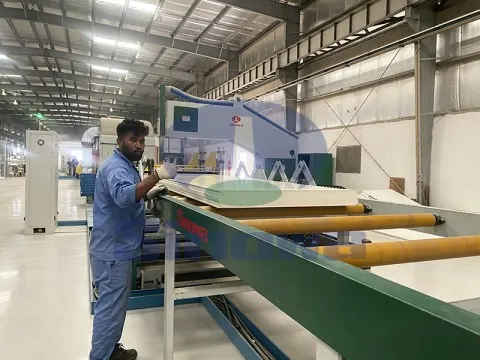
The finished product conveying and stacking subsystem is the terminal unit of the production line, which realizes automatic arrangement and storage of finished panels. This subsystem includes a flat conveying platform, mechanical shifting arms, and intelligent stacking racks. The cooled finished panels are stably transported to the stacking area through the anti-slip conveying platform. The mechanical shifting arms are equipped with flexible clamping structures to avoid extrusion damage to the panel surface; they can accurately grab single panels and place them neatly on the stacking racks according to preset stacking rules. The stacking height and arrangement spacing are adjustable, and the system automatically counts the number of stacked panels to facilitate subsequent packaging and transportation. The entire stacking process is automated without manual intervention, which effectively reduces labor costs and avoids surface contamination caused by human contact. The bottom of the stacking rack is equipped with anti-pressure support components to prevent the bottom panels from being deformed by excessive stacking pressure. Meanwhile, the reserved gaps between stacked panels maintain air circulation, preventing moisture accumulation and mildew on the panel surface during temporary storage.
In terms of driving and control systems, modern polyurethane sandwich panel line adopts a highly integrated automatic control mode dominated by servo transmission. The power driving components of each functional module are connected through a unified transmission system, and the operating frequency and running speed of each unit are synchronized by the central control unit. The servo motors have stable output power and precise speed regulation performance, which can realize stepless speed adjustment within the production speed range. The conventional continuous production speed of medium and large-sized production lines is between 8 meters and 15 meters per minute, and the speed can be dynamically adjusted according to raw material activity and production requirements. The internal control system collects operating data such as equipment temperature, transmission speed, raw material flow, and molding pressure in real time through multiple sensor components. When abnormal data such as raw material blockage, temperature deviation, and material deviation occurs, the system automatically triggers early warning prompts and executes protective actions such as speed reduction and temporary shutdown. The human-computer interaction interface simplifies the parameter setting process, and operators can complete the switching of production specifications and the adjustment of process parameters through simple instruction input. The closed-loop control logic effectively reduces the error rate in the production process and improves the consistency of finished panel quality.
The structural design of polyurethane sandwich panel manufacturing plant contains multiple humanized optimization details adapted to industrial production needs. In terms of material transportation, all transmission pipelines for chemical raw materials are made of corrosion-resistant alloy materials to resist the chemical corrosion of polyurethane raw materials and extend the service life of pipelines. The movable connecting parts of the equipment are equipped with dust-proof and wear-resistant accessories to reduce mechanical friction loss during long-term operation. In terms of safety protection, all high-speed rotating components are wrapped with sealed protective covers, and anti-collision sensors are installed at the material inlet and outlet to prevent equipment damage caused by material jamming. The noise generated by mechanical operation is reduced through shock absorption and sound insulation structures, improving the on-site production environment. In terms of maintenance convenience, the modular assembly structure is adopted for key wearing parts, which can be disassembled and replaced without overall shutdown, shortening the equipment maintenance cycle. The heat generated by the heating components is recycled through the heat exchange system, which reduces energy consumption while lowering the external temperature of the equipment shell and avoiding scalding risks for operators.
Different production process modes endow polyurethane sandwich panel manufacturing plant with diverse application characteristics, and continuous composite molding and intermittent mold pressing molding are the two mainstream production modes. The continuous composite molding equipment adopts an integrated linear layout, realizing uninterrupted feeding, foaming, curing and cutting processes. This type of equipment has high production efficiency and stable product consistency, which is suitable for large-scale mass production of standard-sized panels. The foaming reaction is carried out in a horizontal closed cavity, and the thickness of the panels is controlled by the fixed gap of the double-belt structure. The intermittent mold pressing molding equipment uses independent closed molds for single-batch production; after the raw materials are injected into the molds, the foaming and curing reactions are completed in a static state. This kind of equipment has strong flexibility and can produce special-shaped panels with irregular sizes and curved structures, but the production efficiency is relatively low. In actual industrial application, production enterprises will select matching equipment types according to product positioning and market demand, and some comprehensive production lines are equipped with switching structures of two production modes to meet diversified production requirements.
The technological optimization direction of polyurethane sandwich panel production line is closely linked with the upgrading demands of the new material industry, and energy conservation, intelligence, and environmental protection have become the core optimization trends. In terms of energy saving optimization, the heating system of the curing oven adopts high-efficiency thermal insulation materials to reduce heat loss, and the waste heat generated by mechanical operation is recycled to preheat raw materials and surface materials, effectively reducing comprehensive energy consumption. In terms of intelligent upgrading, the equipment is embedded with data analysis modules to record production parameters such as raw material proportion, curing temperature, and production speed in real time. The system forms an optimal production database through long-term data accumulation, realizing automatic parameter matching for different production requirements. In terms of environmental protection improvement, the closed raw material conveying structure prevents volatile gas leakage, and the waste generated in the production process is classified and recycled. The residual polyurethane foam scraps are crushed and reprocessed into auxiliary raw materials, realizing resource recycling. In addition, the equipment is optimized for low-carbon materials, and the structural accessories are made of recyclable alloy materials to reduce the carbon emission generated by equipment manufacturing and replacement.
In the industrial production chain, polyurethane sandwich panel manufacturing plant undertakes the important task of connecting raw material processing and finished product application, and its performance indicators directly affect the application quality of terminal products. The dimensional accuracy of the equipment is controlled within a tiny tolerance range; the positioning error of material transmission is less than 0.1 millimeters, and the angle deviation of trimming and cutting is controlled within 0.5 degrees. High-precision mechanical control ensures that the assembled panels have excellent fitting performance during on-site construction, avoiding assembly gaps caused by dimensional errors. In terms of structural stability, the equipment can maintain continuous and stable operation for a long time, and the failure rate of key components is effectively reduced through wear-resistant and anti-corrosion design. The long-term operating stability of the equipment ensures the continuity of industrial production and reduces the production cost caused by equipment shutdown and maintenance. Moreover, the adjustable parameter range of the equipment enables it to adapt to raw materials with different formulas, realizing the production of polyurethane sandwich panels with different thermal insulation coefficients, compression resistance, and fire resistance grades.
With the continuous development of the construction industry and cold chain transportation industry, the market demand for high-performance polyurethane sandwich panels is constantly escalating, which also puts forward higher technical requirements for supporting manufacturing equipment. In the future, polyurethane sandwich panel machine will further develop towards full intelligent automation, realizing unmanned monitoring of the entire production process from raw material feeding to finished product warehousing. The sensor system will be upgraded to high-precision intelligent sensing components, which can identify subtle defects such as internal bubble voids and surface indentation of panels in real time. The raw material mixing system will adopt more refined proportional control technology to improve the utilization rate of chemical raw materials and reduce production costs. At the same time, combined with the green production concept, the equipment will strengthen the waste gas purification and waste residue recycling functions to realize zero-pollution discharge in the production process. The structural integration of the equipment will be further optimized to reduce the occupied space of the production line and improve the space utilization rate of production workshops.
In conclusion, polyurethane sandwich panel manufacturing plant is a complex industrial system integrating mechanical transmission, chemical control, thermal processing, and intelligent monitoring technologies. Each functional subsystem has clear division of labor and close connection, jointly completing the whole process from raw material processing to finished panel molding. The structural design, parameter control logic, and process optimization direction of the equipment determine the production efficiency and product quality of polyurethane sandwich panels. With the continuous progress of industrial manufacturing technology, such equipment will continuously break through the limitations of traditional production processes, realize higher efficiency, lower energy consumption, and more environmentally friendly production modes. As the core production carrier of polyurethane sandwich panels, manufacturing equipment will continue to support the diversified application development of composite panels in construction, logistics, and industrial manufacturing fields, and provide reliable technical guarantees for the upgrading of the new composite material industry.
Sinowa is a professional manufacturer of sandwich panel machine in china, we provide diversified and high-performance sandwich panel production lines, including fully automatic continuous PU sandwich panel line and customized special lines to meet mass production and personalized order demands. These sandwich panel lines support processing multiple foam core materials, such as PU, PIR, mineral wool, rock wool and glass wool, covering different insulation and fireproof standards.
Featuring stable operation, high efficiency, energy saving and easy maintenance, our PU sandwich panel line deliver sandwich panels with excellent thermal insulation, fire resistance, sound insulation and lightweight durability. The finished panels are widely applied in industrial workshops, warehouse roofing and wall cladding, cold storage insulation, serving global construction and industrial insulation markets.
https://www.cnsinowa.com/sandwich-panel-machines/polyurethane-sandwich-panel-manufacturing-plant.html