sandwich panel machine
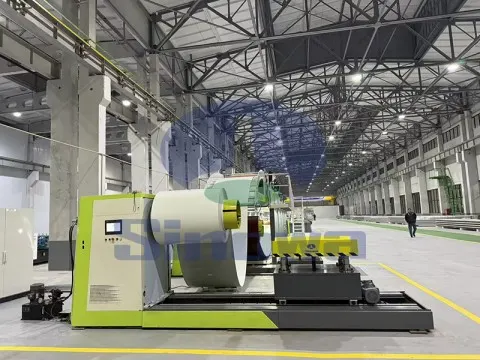
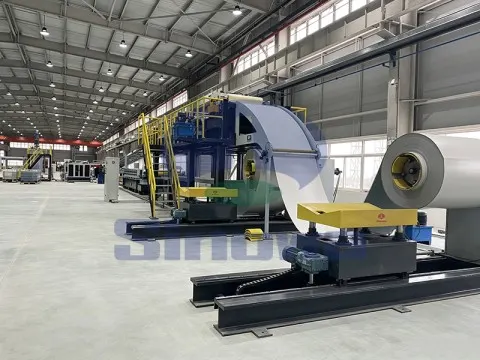
The overall operational logic of continuous PU sandwich panel production machinery is based on synchronous collaborative operation of multi-station functional modules. The production process starts from the feeding and pretreatment of upper and lower surface facing materials, which are the outer protective and bearing layers of sandwich panels. Common facing materials include metal coil sheets with excellent flatness and mechanical toughness, as well as lightweight flexible decorative and protective materials adapted to special scenarios. These coiled raw materials are installed on automatic unwinding devices, which adopt constant tension control structures to ensure stable and uniform material output without wrinkles, deviations, or stretching deformation during high-speed transmission. This stable feeding state is the basic prerequisite for ensuring the flatness, dimensional accuracy, and overall appearance quality of finished panels, avoiding subsequent composite defects caused by uneven surface material transmission.
After unwinding, the surface materials enter the precision pretreatment unit, a key link that determines the bonding performance between the facing layer and the PU foam core. This unit is equipped with integrated surface cleaning and finishing structures, which can effectively remove floating dust, fine debris, and static attachments on the surface of raw materials through physical air cleaning and static elimination technologies. A clean and dry bonding interface completely eliminates hidden dangers such as hollowing, delamination, and insufficient adhesion between the surface layer and the core material in subsequent use. Meanwhile, the pretreatment process includes precise leveling and trimming processing to correct tiny deformations and edge irregularities of the coiled materials, ensuring that the specifications of upper and lower facing materials remain consistent in the subsequent composite molding process.
Subsequently, the processed surface materials pass through the roll forming system, which carries out continuous cold roll forming according to the preset panel structural requirements. Through the gradual pressure adjustment of multiple groups of forming rollers, the flat surface materials are processed into the required plate structure with fixed edge folds and overall flatness. The roll forming structure adopts synchronous transmission design, with each group of rollers operating at matched speeds to avoid material extrusion deformation or surface scratch damage caused by speed difference. The structural parameters of roll forming can be adaptively adjusted according to different panel thicknesses and application standards, realizing flexible processing of diversified product specifications and meeting the customized production needs of different industrial and construction scenarios.
Before the core material compounding process, the surface materials will go through uniform preheating treatment, which is a crucial auxiliary process for optimizing PU foam reaction and bonding effect. The built-in circulating heating system of the equipment maintains a stable and uniform temperature environment in the preheating area, enabling the surface materials to reach the optimal temperature state required for foam bonding. This treatment can effectively eliminate the temperature difference on the material surface, avoid inconsistent foam reaction speed caused by uneven temperature, and ensure that the PU core material can form a tight and uniform bonding layer with the surface materials in the subsequent foaming process, greatly improving the overall structural firmness and service durability of the sandwich panel.
The PU raw material metering, mixing and pouring system is the core functional component of the entire continuous production machinery, which directly determines the internal structure density, thermal insulation performance and structural stability of the sandwich panel core layer. This system realizes precise proportional conveying of two or more polyurethane chemical raw materials through high-precision metering power structures, and the proportion parameters can be finely adjusted according to the performance requirements of different panels such as thermal insulation, fire resistance and compression resistance. After accurate proportioning, the raw materials enter the high-pressure mixing mechanism for full instantaneous mixing, ensuring that the chemical components are evenly fused without local concentration difference or incomplete reaction. The uniformly mixed PU liquid materials are continuously and linearly poured between the upper and lower moving surface materials through an automatic pouring nozzle, realizing uninterrupted feeding of core materials and laying a foundation for continuous molding of panels.
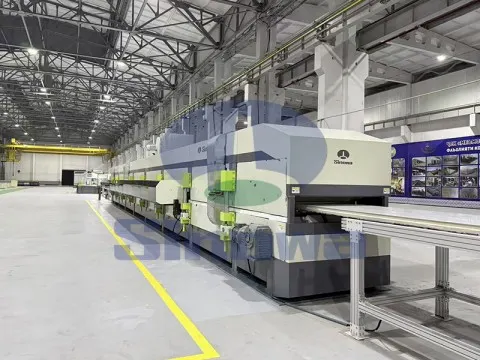
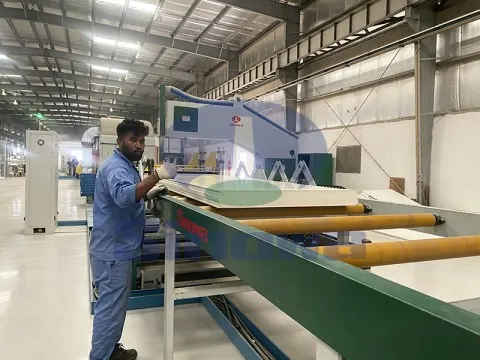
Following the pouring process, the materials enter the double-belt lamination and constant-temperature curing system, the core molding link of sandwich panels. The upper and lower synchronous crawler conveyor structures of the equipment can stably clamp the composite materials, accurately lock the panel thickness specifications through mechanical limit structures, and offset the expansion pressure generated by PU foaming reaction to ensure uniform thickness of the whole panel without local bulging or thinning. The internal closed circulating constant-temperature system maintains a stable reaction and curing environment in the molding area, enabling the PU materials to complete uniform foaming, filling and rapid curing reaction in a controllable temperature range. The foaming speed and curing cycle are completely matched with the material transmission speed of the sandwich panel assembly line, realizing dynamic balance between continuous transmission and static molding, and ensuring that each section of the panel has consistent internal foam pore structure and compactness.
The structural design of the double-belt conveyor fully considers the continuity and stability of long-term operation. The high-precision integral processing technology ensures the flatness and parallelism of the upper and lower conveyor belts, so that the stress on the panel surface is uniform during the lamination and curing process. The independent upper and lower hot air circulation circuits can adjust the temperature gradient according to the panel thickness and production speed, ensuring that the internal and external curing degree of the PU core material is consistent, avoiding quality problems such as incomplete internal curing and excessive surface curing. After long-term curing and shaping, the initially formed sandwich panel has stable overall structure, reliable bonding performance and uniform internal organization.
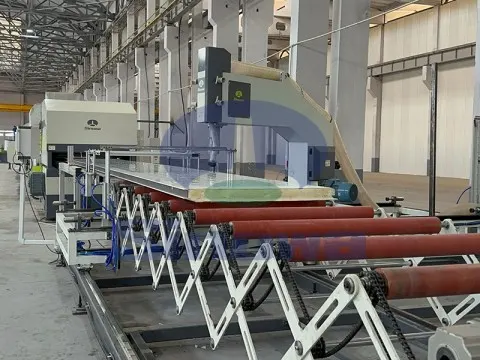
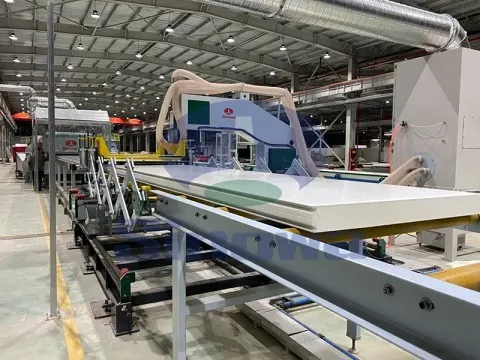
After completing curing and primary shaping, the continuous long-strip panel enters the fixed-length cutting and finishing unit. The high-speed synchronous cutting mechanism can realize dynamic cutting following the sandwich panel production line operation, without stopping the whole line or affecting the continuous production rhythm. The cutting system adopts precise positioning and sensing devices, which can automatically identify the preset panel length specifications and complete flat and neat cutting operations. The cutting tool structure is optimized to ensure smooth panel end faces without burrs, collapses or irregular cuts, reducing subsequent manual finishing procedures. Meanwhile, the equipment is equipped with edge trimming and finishing functions to fine-tune the panel edge size and flatness, ensuring that the overall dimensional error of finished products is controlled within a tiny range and meeting high-precision engineering application standards.
The cut single panels are then transported to the cooling and shaping area through the automatic conveying system. Although the panels have completed the main curing reaction, natural residual temperature exists inside the materials. The circulating air cooling structure of the equipment can uniformly dissipate heat from the surface and interior of the panels, realizing rapid and stable shaping of the panels and avoiding structural deformation or surface wrinkles caused by residual temperature stress during stacking and storage. The cooling process is set with graded temperature reduction parameters according to different panel thicknesses and core material formulas, ensuring that the internal structural stress of the panels is completely released, further improving the dimensional stability and long-term service performance of the products.
The final stage of the production process is automatic stacking and auxiliary packaging conveying. The finished panels after cooling and shaping are automatically sorted, arranged and stacked by the mechanical stacking device, which can adjust the stacking quantity and arrangement mode according to product specifications. The automatic stacking system replaces manual handling, effectively reducing labor costs, avoiding surface scratch and damage caused by manual operation, and improving the neatness and uniformity of finished product stacking. The stacked finished products can be directly connected to the subsequent packaging and conveying links, realizing fully automated closed-loop operation from raw material feeding to finished product storage, greatly improving the overall production efficiency of the enterprise.
The core advantages of continuous PU sandwich panel machine are mainly reflected in its high integration, high stability and high production efficiency. Different from discontinuous production equipment that needs frequent startup, shutdown and parameter adjustment, the continuous sandwich panel line can realize long-term uninterrupted operation after parameter debugging is completed. All functional modules are controlled by a unified intelligent control system, which realizes synchronous matching of transmission speed, reaction temperature, raw material proportioning, cutting parameters and other core data. The system can automatically monitor the operating state of each link in real time, automatically adjust deviation parameters when tiny parameter fluctuations occur, and maintain the consistency and stability of the production process, thus ensuring that the performance and specifications of each batch of finished panels are highly unified.
In terms of structural performance optimization, the mechanical design of the whole equipment focuses on durability and low maintenance. The key transmission and bearing components adopt reinforced structural design, which can adapt to long-term high-load continuous operation and reduce the frequency of equipment failure and shutdown maintenance. The modular structural layout enables each functional unit to operate independently and coordinate with each other, which is convenient for daily inspection, maintenance and partial component replacement, effectively reducing the later operation and maintenance cost of the equipment. At the same time, the equipment is equipped with perfect linkage protection structures, which can realize automatic shutdown and fault prompt in case of abnormal material transmission, parameter deviation or equipment failure, avoiding equipment damage and unqualified product output, and improving the safety and reliability of production operation.
In terms of production quality control, the precise chemical reaction control system of continuous PU sandwich panel production machine fundamentally optimizes the internal quality of sandwich panels. The high-precision metering and mixing technology ensures the uniformity of PU core material components, making the foam pore structure of the core layer fine and uniform, and endowing the panels with excellent and stable thermal insulation, sound insulation and compression resistance. The integrated composite molding process makes the facing layer and the core layer form an integral bonding structure, effectively improving the overall structural strength and peeling resistance of the panels, so that the products can maintain stable performance in complex environments such as high temperature, low temperature and alternating cold and heat for a long time.
From the perspective of industrial production benefits, the continuous production mode greatly improves the unit output efficiency of sandwich panel manufacturing. The uninterrupted production process eliminates the time loss caused by frequent startup and shutdown, material replacement and equipment debugging in intermittent production, and significantly improves the effective production time and single-line output. The highly automated operation mode reduces the dependence on manual operation, realizes centralized control of the whole production process, effectively reduces human error in production, improves the yield of finished products, and optimizes the comprehensive production cost of enterprises. In addition, the flexible parameter adjustment function of the equipment enables it to adapt to the production of sandwich panels for multiple scenarios, covering lightweight building enclosure, thermal insulation engineering, industrial purification workshops, cold storage enclosure and other fields, with strong market adaptability and production flexibility.
With the continuous upgrading of the composite material manufacturing industry, continuous PU sandwich panel machinery is also evolving towards higher intelligence, higher precision and more energy-saving operation. The optimized temperature control system and power transmission structure effectively reduce energy consumption per unit product, realizing green and low-carbon production. The intelligent data monitoring and recording function can record all production parameters in real time, providing accurate data support for production quality traceability, process optimization and production schedule adjustment. The continuous innovation of mechanical structure and control technology further expands the performance boundary of PU sandwich panels, promotes the continuous improvement of product quality and application level, and provides reliable core equipment support for the high-quality development of the modern building thermal insulation and composite material industry.
Sinowa is a professional manufacturer of sandwich panel machine in china, we provide diversified and high-performance sandwich panel production lines, including fully automatic continuous PU sandwich panel line and customized special lines to meet mass production and personalized order demands. These sandwich panel lines support processing multiple foam core materials, such as PU, PIR, mineral wool, rock wool and glass wool, covering different insulation and fireproof standards.
Featuring stable operation, high efficiency, energy saving and easy maintenance, our PU sandwich panel line deliver sandwich panels with excellent thermal insulation, fire resistance, sound insulation and lightweight durability. The finished panels are widely applied in industrial workshops, warehouse roofing and wall cladding, cold storage insulation, serving global construction and industrial insulation markets.
https://www.cnsinowa.com/sandwich-panel-machines/continuous-pu-sandwich-panel-production-machinery.html