sandwich panel machine
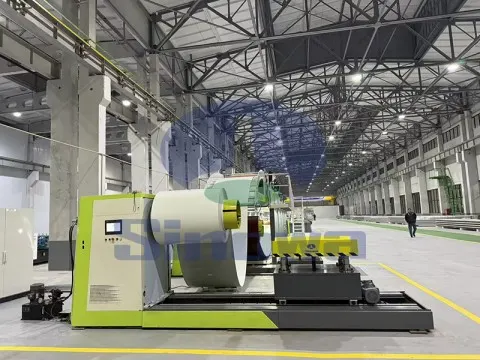
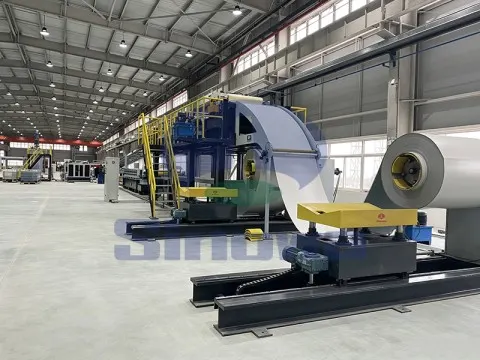
The automatic conveying system serving the PU sandwich panel production machine is not a simple combination of conventional transmission rollers and conveyor belts, but a customized and precisely calibrated intelligent transmission mechanism designed according to the physical characteristics of metal surface materials, the chemical foaming and curing cycle of PU core materials, and the technological rhythm of each production processing section. Every component inside the conveying system is carefully matched in terms of transmission speed, bearing capacity, running stability, and positioning accuracy, ensuring that all raw materials and semi-finished panels can maintain a stable and continuous conveying state without deviation, vibration, or speed fluctuation during the entire production process. The front-end part of the automatic conveying system is connected to the raw material unwinding and feeding area, responsible for stably conveying coiled metal surface materials, the main raw material for the outer layer of PU sandwich panels, into the subsequent roll forming and leveling links. In this initial conveying stage, the system adopts variable-frequency speed regulation linkage control, which can automatically adjust the initial conveying speed according to the real-time feeding progress of the metal coils and the operating status of the roll forming equipment behind it. This synchronous speed adjustment function effectively avoids material stretching, wrinkling, or uneven tension caused by inconsistent feeding and processing speeds, which could affect the flatness and overall appearance quality of the final sandwich panel surface. Meanwhile, the conveying rollers in the front-end section are made of wear-resistant and anti-slip special materials, with a surface smoothness treated finely to prevent scratching or damaging the coated protective layer on the surface of the metal materials during long-term continuous conveying, ensuring that the outer surface of the produced PU sandwich panels maintains a smooth and beautiful finish without surface defects.
After the metal surface materials are conveyed to the roll forming area by the front-end automatic conveying mechanism, the conveying system still maintains precise synchronous coordination with the roll forming processing equipment throughout the whole process. The roll forming process requires the metal sheet to pass through multiple forming stations at a constant and stable speed to complete the bending, pressing, and shaping of different edge structures and surface profiles, and any sudden change in conveying speed or slight position deviation will lead to unqualified forming dimensions and inconsistent profile shapes of the metal sheet. The automatic conveying system is equipped with real-time position detection and speed feedback sensing modules at each key forming station, which can monitor the running state of the metal sheet in real time and feed the detected data back to the centralized control terminal of the entire production line in a timely manner. The control terminal automatically fine-tunes the operating parameters of the conveying system according to the feedback data, realizing dynamic synchronization between conveying and forming processing. After the completion of roll forming and leveling treatment, the automatic conveying system will steadily transport the shaped upper and lower metal surface materials to the preheating treatment area. The preheating process is a key preliminary link to ensure the strong bonding between the PU foam core material and the metal surface materials, and the conveying speed at this stage is matched with the preheating temperature control cycle, ensuring that each section of the metal material can obtain uniform and moderate heating time, neither causing local overheating to damage the surface coating nor insufficient heating affecting the subsequent bonding effect between the core material and the surface layer.
The middle section of the automatic conveying system corresponds to the core production link of the entire PU sandwich panel machine, namely the PU raw material mixing, foaming, and composite laminating stage, which is also the most critical stage that determines the thermal insulation performance and structural bonding strength of the finished sandwich panels. After preheating, the lower metal surface material is continuously and stably conveyed to the PU foaming and pouring station under the drive of the automatic conveying system. At this station, the high-precision PU raw material dosing and mixing device uniformly mixes the two-component polyurethane raw materials in a scientific proportion and sprays the mixed liquid foam material evenly on the surface of the lower metal sheet. The operating speed of the conveying system at this moment is precisely locked with the foam spraying flow and foaming expansion rate, ensuring that the liquid PU material can be distributed evenly and continuously on the surface of the metal sheet without accumulation, fracture, or uneven thickness. This precise speed matching avoids the quality problems of inconsistent core material density, local hollowing, or uneven foam thickness inside the sandwich panel, which are easily caused by asynchronous conveying and spraying in traditional production processes. Immediately after the PU foam spraying is completed, the automatic conveying system quickly and accurately conveys the upper metal surface material to the corresponding position for precise alignment with the lower material, forming a complete sandwich composite structure with the PU foam layer sandwiched in the middle. The positioning and conveying accuracy of the system in this alignment process is extremely high, effectively preventing the deviation of the upper and lower metal materials, ensuring that the overall thickness and edge flatness of the composite sandwich structure meet uniform production standards.
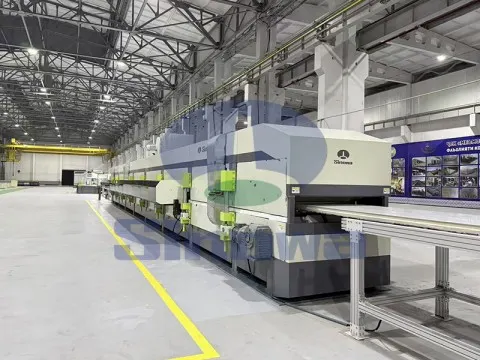
Subsequently, the automatic conveying system transports the initially compounded sandwich semi-finished product to the continuous pressing and curing section, where the PU foam core material completes foaming expansion, chemical curing, and firm bonding with the upper and lower metal surface materials. The pressing and curing process has strict requirements on conveying stability and residence time, and the automatic conveying system adopts a slow and constant-speed conveying mode in this section to ensure that the semi-finished panel stays in the constant-temperature pressing mold for a sufficient and standardized curing time. The internal double-belt conveying structure of the pressing and curing section works synchronously up and down, maintaining uniform pressure on the upper and lower surfaces of the sandwich panel during conveying, which not only promotes the full foaming and dense molding of the PU core material but also strengthens the bonding tightness between the foam core and the metal surface layers, effectively avoiding common quality defects such as delamination, cracking, and poor adhesion of finished panels. The entire pressing and curing process does not require any manual adjustment or material transfer operation, and the automatic conveying system independently completes the whole process of stable conveying, constant-pressure maintenance, and gradual output after curing according to the preset production program, greatly reducing the impact of human operation errors on product quality and making the bonding strength and structural stability of each batch of PU sandwich panels highly consistent.
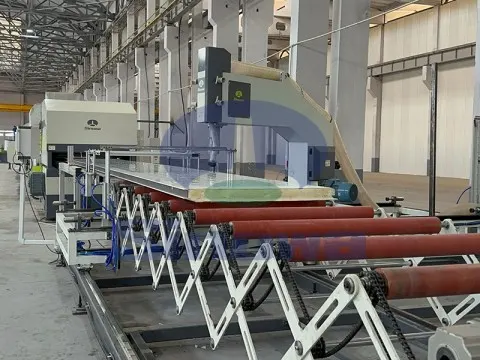
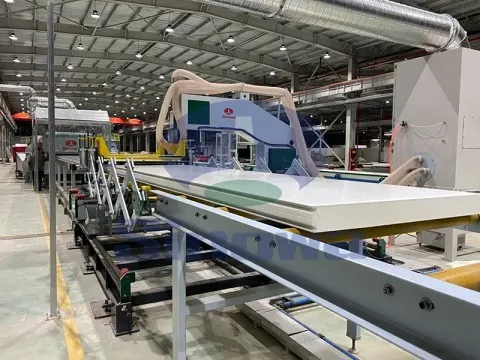
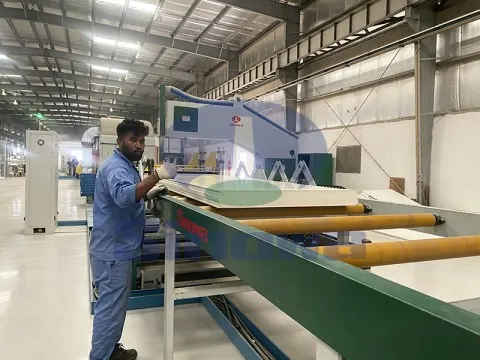
The rear-section operation of the automatic conveying system covers the cooling and shaping, fixed-length cutting, finished product conveying, and temporary storage and stacking links of PU sandwich panels, realizing the seamless connection from semi-finished cured panels to final finished products. After being output from the pressing and curing section, the initially shaped sandwich panels are transported to the natural cooling and shaping area by the automatic conveying system, and the conveying speed in this area is reasonably set according to the ambient temperature and the overall thickness of the panels, ensuring that the internal stress of the panels is fully released during the slow conveying process and the overall shape is stabilized, preventing subsequent deformation or warping of the finished panels due to uneven cooling. After cooling and shaping, the conveying system accurately sends the panels to the intelligent fixed-length cutting station, and cooperates with the cutting equipment to complete precise cutting according to the customized length requirements of different orders. During the cutting process, the automatic conveying system has a temporary positioning and locking function, which can fix the panel position instantly when cutting starts to ensure cutting accuracy, and automatically resumes conveying after cutting is completed to transport the cut finished panels to the subsequent finished product sorting and stacking area. The whole process from cooling to cutting and then to finished product output is fully automated, with no need for manual handling or auxiliary positioning, making the entire production process more smooth and efficient.
The application of the automatic conveying system brings multiple core advantages to the overall operation of the PU sandwich panel machine, covering production efficiency improvement, product quality stability, production cost control, and operational safety optimization, which are far beyond the reach of traditional production equipment without automatic conveying configuration. In terms of production efficiency, the automatic conveying system realizes the complete continuity of the entire production process, eliminating the production stagnation and waiting time caused by manual material transfer, segmented docking, and temporary material storage in traditional production modes. All production links are closely connected and operate synchronously under the coordination of the conveying system, and the effective production time of the equipment is greatly increased, enabling the production line to maintain a stable high-yield operating state for a long time and meet the large-scale order production needs of different enterprises. In terms of product quality control, the standardized and unified conveying speed, precise positioning accuracy, and stable operating state of the automatic conveying system make the production conditions of each PU sandwich panel completely consistent in all links including material feeding, foaming, pressing, curing, and cutting. There is no quality fluctuation caused by different manual operation habits or different handling speeds, so the produced panels have uniform thickness, stable internal foam density, firm bonding between layers, and consistent surface flatness, with extremely low product defect rate and excellent overall quality uniformity.
In terms of production cost optimization, the PU sandwich panel machine equipped with an automatic conveying system greatly reduces the number of on-site production workers required. Traditional production lines need special personnel to be responsible for material handling, material docking, position adjustment, and auxiliary conveying in each link, while the automatic conveying system realizes unmanned automatic operation of the whole process, only requiring a small number of operators to be responsible for production parameter setting, equipment operation monitoring, and daily equipment maintenance. This greatly reduces labor input and labor management costs for enterprises. At the same time, the stable conveying operation of the system reduces material waste caused by manual handling errors, material deviation, and product quality defects, improving the utilization rate of raw materials and further reducing the comprehensive production cost per unit of finished panels. In terms of production safety, the automatic conveying system realizes closed and automated material transmission in the whole production process, reducing the contact frequency between workers and high-temperature processing areas, mechanical moving parts, and chemical foaming operation areas, effectively avoiding various potential safety hazards easily caused by manual on-site operation, improving the overall safety level of the production workshop, and creating a more standardized and safe working environment for production operators.
In actual industrial production and application scenarios, the automatic conveying system of the PU sandwich panel machine also has good flexibility and adjustable adaptability, which can meet the diversified production needs of different industries and different application scenarios. By simply adjusting the operating speed, conveying spacing, and positioning parameters of the automatic conveying system through the centralized control terminal, the production line can quickly switch between producing PU sandwich panels of different thicknesses, different widths, and different surface material specifications, including roof insulation panels for industrial factory buildings, wall partition panels for steel structure buildings, cold chain thermal insulation panels for refrigeration warehouses, and thermal insulation composite panels for special environmental protection facilities. The entire parameter adjustment process is simple and efficient, without the need for complex mechanical disassembly and manual debugging, enabling enterprises to quickly respond to market order changes and flexibly adjust production products. In addition, the automatic conveying system is designed with a humanized fault detection and emergency protection mechanism. Once abnormal conditions such as material jamming, conveying deviation, or equipment overload occur during the conveying process, the system will automatically trigger an emergency stop function, send out abnormal alarm prompts, and record fault information synchronously, which is convenient for maintenance personnel to quickly troubleshoot and handle faults, reducing equipment downtime and ensuring the continuity and stability of production work.
With the continuous upgrading of construction industrialization and cold chain logistics development, the market requirements for the quality precision, production efficiency, and product diversification of PU sandwich panels are constantly improving, and the importance of PU sandwich panel machines with automatic conveying systems in the modern composite material manufacturing industry will become more prominent. The perfect coordination between the automatic conveying system and the main production equipment not only optimizes the internal production process of the equipment but also promotes the overall upgrading of the PU sandwich panel manufacturing industry towards intelligence, automation, and standardization. For production enterprises, choosing such advanced production equipment can not only improve core production competitiveness and meet the increasingly stringent market product quality requirements but also realize long-term stable and low-cost production operation. For the entire downstream application industry of PU sandwich panels, the high-quality and high-efficiency mass production brought by the equipment provides reliable and high-quality basic composite materials for the construction of energy-saving buildings, cold chain storage facilities, and industrial supporting projects, contributing to the steady development and technological progress of related industries. In the future, with the continuous technological optimization and innovation of automatic conveying and intelligent control technology, the comprehensive performance of PU sandwich panel machines will be further improved, and the automatic conveying system will play a more core and important role in promoting the high-quality development of the entire composite insulation material manufacturing industry.
Sinowa is a professional manufacturer of sandwich panel machine in china, we provide diversified and high-performance sandwich panel production lines, including fully automatic continuous PU sandwich panel line and customized special lines to meet mass production and personalized order demands. These sandwich panel lines support processing multiple foam core materials, such as PU, PIR, mineral wool, rock wool and glass wool, covering different insulation and fireproof standards.
Featuring stable operation, high efficiency, energy saving and easy maintenance, our PU sandwich panel line deliver sandwich panels with excellent thermal insulation, fire resistance, sound insulation and lightweight durability. The finished panels are widely applied in industrial workshops, warehouse roofing and wall cladding, cold storage insulation, serving global construction and industrial insulation markets.
https://www.cnsinowa.com/sandwich-panel-machines/pu-sandwich-panel-machine-with-automatic-conveying-system.html