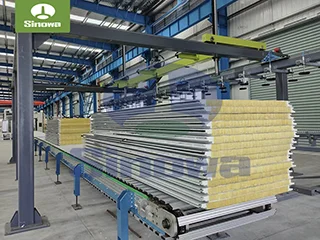
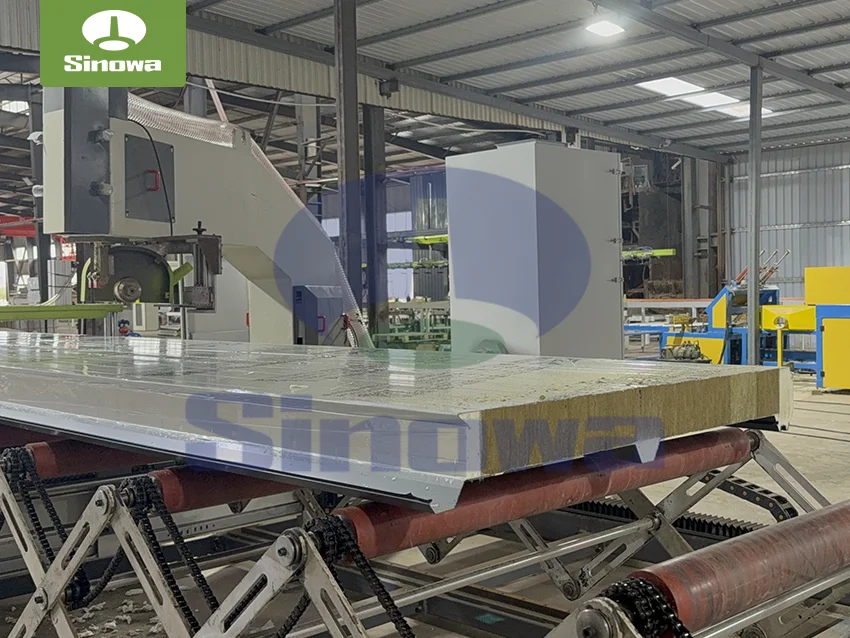
 sandwich panel line
The foundation of a high-efficiency production line lies in its rational layout and seamless integration of core functional modules. Unlike traditional production setups that rely heavily on manual intervention and suffer from disjointed processes, modern high-efficiency lines adopt a modular design philosophy, where each unit operates in perfect synergy with the others. From raw material preparation to final packaging, every stage is optimized to minimize downtime, reduce material waste, and maximize output. The key to achieving high efficiency lies not only in the speed of individual machines but also in the smooth transition between processes, which is made possible by advanced control systems and intelligent conveying mechanisms. This holistic approach ensures that the production line can operate continuously for extended periods, a critical factor in meeting the large-volume orders common in today's construction industry.
Raw material preparation is the first critical stage in the production of rock wool sandwich panels, and high-efficiency lines are designed to handle this process with precision and speed. For the outer metal sheets, which typically serve as the structural and protective layer of the panels, the production line starts with uncoiling and leveling of steel coils. The steel coils, made from high-quality steel alloyed with elements to enhance ductility and strength, are fed into an uncoiling machine that unwinds them smoothly. A precision leveling system then removes any distortions or unevenness from the steel sheet, ensuring a flat surface that is essential for subsequent forming and bonding processes. This stage is automated, with sensors monitoring the thickness and flatness of the steel sheet in real time, adjusting parameters automatically to maintain consistency. The use of automated uncoiling and leveling not only speeds up the process but also reduces material waste caused by manual errors.
Following leveling, the steel sheets undergo a forming process to create the desired profile, which can vary depending on the application—such as corrugated for roofing panels or flat for wall panels. High-efficiency production lines are equipped with advanced roll forming machines that use a series of precisely calibrated rollers to shape the steel sheets gradually. The roll forming process is computer-controlled, allowing for quick adjustments to accommodate different panel sizes and profiles without the need for time-consuming manual retooling. This flexibility is a key advantage in meeting the diverse needs of construction projects, from standard-sized industrial warehouses to custom-designed public buildings. After forming, the steel sheets are pre-treated to enhance the adhesion of the adhesive and improve corrosion resistance. This pre-treatment typically involves chemical cleaning and priming, processes that are also automated to ensure uniform coverage and consistent results.
The preparation of the rock wool core, the heart of the sandwich panel's thermal and acoustic performance, is another area where high-efficiency production lines excel. Rock wool is made from natural basalt and other silicate rocks, which are melted at extremely high temperatures—typically above 1500℃—and then fibrosis through a centrifugal process. In high-efficiency lines, the rock wool preparation system is fully integrated with the main production line, ensuring a continuous supply of high-quality core material. The raw rock materials are fed into a melting furnace automatically, with the temperature and feed rate controlled precisely by computer systems to maintain the optimal viscosity of the molten rock. The molten rock is then extruded into a high-speed centrifugal machine, where it is spun into fine fibers. During this process, a binding agent and dust-suppressant oil are sprayed onto the fibers uniformly to ensure they bond together effectively and reduce dust emissions.
After fibrosis, the rock wool fibers are collected on a conveyor belt to form a loose mat, which is then fed into a curing oven. The curing process takes place at temperatures between 200-300℃, where the binding agent undergoes cross-linking to form a rigid, stable structure. High-efficiency curing ovens are designed with precise temperature control and uniform air circulation, ensuring that the rock wool core is cured consistently throughout its thickness. Once cured, the rock wool core is cut into the required dimensions using high-precision cutting machines. These machines are equipped with advanced cutting tools and computer numerical control (CNC) systems, allowing for precise cuts and smooth edges. In some high-efficiency lines, the rock wool core is also subjected to a vertical fiber orientation process, where the fibers are rotated 90 degrees to enhance the structural strength of the final panel. This process involves automated conveying and flipping mechanisms that ensure the fibers are oriented correctly without damaging the core structure.
The bonding process, where the rock wool core is sandwiched between the two pre-formed steel sheets, is the most critical stage in ensuring the quality and performance of the final panel. High-efficiency production lines use advanced composite bonding technology, typically involving high-pressure thermal lamination. The pre-treated steel sheets and cut rock wool core are fed into a continuous lamination machine, where they are aligned precisely. The adhesive, which is typically a high-performance polyurethane or phenolic resin, is applied to the inner surfaces of the steel sheets using automated spraying systems. These systems ensure uniform adhesive coverage, with the amount of adhesive controlled precisely to optimize bonding strength while minimizing waste.
Once the adhesive is applied, the steel sheets and rock wool core are fed into a double-track hot press, where they are compressed under controlled temperature and pressure. The temperature in the press is carefully regulated to activate the adhesive, ensuring a strong bond between the steel sheets and the rock wool core. The pressure applied is uniform across the entire surface of the panel, ensuring that there are no gaps or weak spots in the bond. The speed of the lamination process is synchronized with the other stages of the production line, allowing for continuous operation. After lamination, the continuous panel blank is fed into a high-speed flying saw, which cuts it into the required lengths with high precision. The flying saw operates in sync with the movement of the panel blank, ensuring clean, straight cuts without stopping the production line—a key feature that contributes to high efficiency.
Quality control is an integral part of the high-efficiency production process, with advanced monitoring systems in place to detect and correct any defects in real time. Throughout the production line, sensors and cameras are installed to monitor various parameters, such as the thickness of the steel sheets, the density of the rock wool core, the uniformity of the adhesive application, and the bonding strength of the panel. These sensors feed data to a central control system, which analyzes the information and makes automatic adjustments to the production parameters if any deviations are detected. For example, if the sensor detects that the rock wool core is too thin, the feed rate of the rock wool preparation system is adjusted automatically to correct the thickness. Similarly, if the adhesive coverage is uneven, the spraying system is adjusted to ensure uniform application.
In addition to real-time monitoring, high-efficiency production lines also incorporate automated quality inspection at the end of the production process. Finished panels are inspected for dimensional accuracy, surface flatness, and edge quality using advanced optical inspection systems. Any panels that do not meet the quality standards are automatically rejected and diverted to a waste collection system. This automated quality control not only ensures that only high-quality panels reach the market but also reduces the need for manual inspection, further improving production efficiency. The data collected during the quality control process is also stored in a database, allowing for traceability and continuous improvement of the production process.
The final stage of the production process is packaging and stacking, which is also fully automated in high-efficiency lines. After passing the quality inspection, the finished panels are conveyed to an automated stacking machine, which stacks them neatly according to the required quantity and dimensions. The stacked panels are then wrapped in protective film using an automated packaging machine to prevent damage during transportation and storage. Some high-efficiency lines also include automated labeling systems that apply product information labels to the packages. The entire packaging and stacking process is designed to be fast and efficient, with minimal manual intervention. This not only reduces labor costs but also ensures that the panels are packaged consistently, reducing the risk of damage and improving customer satisfaction.
One of the key advantages of high-efficiency rock wool sandwich panel production lines is their energy efficiency and environmental friendliness. Modern lines are designed with energy-saving technologies, such as high-efficiency motors, heat recovery systems, and insulation materials, which reduce energy consumption significantly. For example, the melting furnace used in rock wool production is equipped with heat recovery systems that capture waste heat and reuse it for heating other parts of the production line. This not only reduces energy costs but also lowers carbon emissions. In addition, high-efficiency lines are designed to minimize material waste. The precise cutting and forming processes ensure that the raw materials are used efficiently, with any waste material—such as rock wool trimmings and steel scrap—collected and recycled. This circular approach to production not only reduces environmental impact but also improves the economic efficiency of the production process.
The high production efficiency of these lines is reflected in their output capacity. A typical high-efficiency rock wool sandwich panel production line can achieve a production speed of 4-16 meters per minute, with an annual output of up to 800,000 square meters or more. This is significantly higher than traditional production lines, which typically have a production speed of 1-3 meters per minute. The ability to produce large volumes of panels quickly is a critical advantage in meeting the tight deadlines of modern construction projects, where delays can result in significant costs. In addition, the high efficiency of these lines allows manufacturers to meet the growing demand for rock wool sandwich panels in emerging markets, where urbanization and industrialization are driving the need for high-quality construction materials.
Another advantage of high-efficiency production lines is their reduced reliance on manual labor. Traditional production lines require a large number of workers to operate machines, handle materials, and perform quality inspections. In contrast, high-efficiency lines are fully automated, with only a small number of operators required to monitor and control the production process from a central control room. The central control system uses a human-machine interface (HMI) that is intuitive and easy to operate, allowing operators to monitor all stages of the production process in real time, adjust parameters, and troubleshoot any issues quickly. This reduction in manual labor not only lowers labor costs but also reduces the risk of human error, which is a common cause of quality defects and production delays. The automated systems also include fault diagnosis functions, which can detect and alert operators to potential issues before they escalate into major problems, minimizing downtime.
The versatility of high-efficiency rock wool sandwich panel production lines is another key feature that makes them indispensable in the modern construction industry. These lines can be configured to produce a wide range of panel types, including wall panels, roof panels, cold storage panels, and interior partition panels. By adjusting the production parameters, changing the profile of the steel sheets, or modifying the thickness and density of the rock wool core, manufacturers can produce panels that meet the specific requirements of different applications. For example, roof panels may have a corrugated profile to enhance water drainage, while cold storage panels may have a higher density rock wool core to improve thermal insulation. This versatility is made possible by the modular design of the production line, which allows for quick and easy reconfiguration without major modifications to the equipment. This ability to adapt to different production needs is a significant advantage in a market where customer requirements are increasingly diverse.
The performance of the rock wool sandwich panels produced by high-efficiency lines is consistently high, thanks to the precise control of the production process. The panels exhibit excellent thermal insulation properties, with low thermal conductivity that helps reduce energy consumption in buildings. Their fire resistance is also exceptional, as rock wool is inherently non-combustible and does not release toxic gases when exposed to fire. This makes rock wool sandwich panels an ideal choice for buildings where fire safety is a top priority, such as hospitals, schools, and high-rise buildings. In addition, the panels have excellent sound absorption properties, helping to create a quiet and comfortable indoor environment. The structural stability of the panels is also enhanced by the advanced bonding process, ensuring that they can withstand the rigors of transportation, installation, and long-term use.
The application of high-efficiency rock wool sandwich panel production lines has a significant impact on the construction industry. By increasing production efficiency and reducing costs, these lines make rock wool sandwich panels more accessible to a wider range of construction projects, from small-scale residential buildings to large-scale infrastructure projects. The consistent quality of the panels also helps improve the overall quality and safety of buildings, contributing to the development of sustainable and resilient construction practices. In addition, the energy efficiency and environmental friendliness of these production lines align with the global trend towards green manufacturing, helping to reduce the carbon footprint of the construction industry.
Looking to the future, the development of high-efficiency rock wool sandwich panel production lines is likely to focus on further improving automation, integrating artificial intelligence (AI) and Internet of Things (IoT) technologies, and enhancing sustainability. AI-powered control systems could optimize production parameters in real time based on historical data and current production conditions, further improving efficiency and reducing waste. IoT technologies could enable remote monitoring and maintenance of the production line, allowing operators to monitor performance and troubleshoot issues from anywhere in the world. In terms of sustainability, future lines may incorporate more recycled materials into the production process and further reduce energy consumption and carbon emissions. These advancements will continue to drive the evolution of the rock wool sandwich panel manufacturing industry, making it more efficient, sustainable, and responsive to the needs of the modern construction sector.
In conclusion, the high-production-efficiency rock wool sandwich panel production line represents a significant leap forward in manufacturing technology. Through its integrated, automated design, it achieves high output, consistent quality, and low costs, while also meeting the growing demand for sustainable construction materials. From raw material preparation to final packaging, every stage of the production process is optimized to ensure seamless operation and maximum efficiency. The versatility of these lines allows them to meet the diverse needs of construction projects, while their energy efficiency and environmental friendliness align with global sustainability goals. As the construction industry continues to evolve, the high-efficiency rock wool sandwich panel production line will remain a key enabler of innovation, helping to build safer, more efficient, and more sustainable buildings for the future.
https://www.cnsinowa.com/sandwich-panel-machines/rock-wool-sandwich-panel-production-line-with-high-production-efficiency.html